Murshidabad Silk: The Golden Thread of India’s Handloom Legacy
When we speak of India’s silk heritage, one name holds a quiet yet commanding presence - Murshidabad Silk. Revered for its softness, luminous sheen, and cultural depth, Murshidabad silk is not merely a fabric. It is history woven by hand.
At Banbithi, where craft and culture form the soul of creation, Murshidabad silk represents everything we stand for - tradition, patience, and timeless elegance.
What Is Murshidabad Silk?
Murshidabad silk is a fine variety of mulberry silk, known for being exceptionally soft, lightweight, lustrous, skin-friendly, and naturally hypoallergenic. It is produced from the Bombyx mori silkworm and cultivated in the historic region of Murshidabad, one of India’s oldest and most prestigious silk clusters.
Its natural golden sheen and fluid texture have earned it the title - “The Queen of Weaving.”
A Silk That Traveled the World
The story of Murshidabad silk dates back to the 13th century, but its global journey began much later. During the 17th century, foreign traders recognized the extraordinary quality of this silk.
In 1658, the British East India Company established its trading post (kuthi) at Kashimbazar (Cossimbazar). Soon after, the Dutch, Portuguese, and French followed, turning Murshidabad into a thriving international silk hub.
Thanks to the river routes of the Bhagirathi and the Ganges, Murshidabad silk began its journey across Europe and beyond, admired for its rich texture, durability, and radiant finish.
In many ways, Murshidabad silk was one of India’s first global textiles.
The Fabric That Shaped India’s Silk Tradition
From Murshidabad, the art of silk production traveled south with the patronage of Tipu Sultan, laying the foundation for what we now know as Mysore silk.
Murshidabad didn’t just create silk -
it influenced the future of Indian weaving.
Four Seasons of Silk
Murshidabad silk threads are cultivated across four seasons each year:
-
November
-
March
-
April
-
August
Among them, the November harvest (Agrahayan season) is considered the most prized - producing threads that are exceptionally lustrous, strong, and refined.
From Cocoon to Saree: A Labour of Love
Once the silk threads are ready, they go through a meticulous hand-processing journey using traditional tools like:
-
Charkha
-
Latai
-
Charkhi
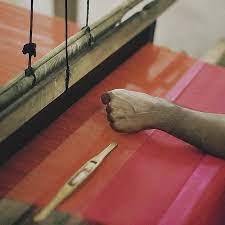
The threads are carefully reeled and then woven using the tana–bana (warp–weft) handloom technique, with the help of a maku (shuttle).
Even today, Murshidabad silk can only be woven on traditional handlooms. It has never been, and cannot be, authentically produced on powerlooms.
To create one Murshidabad silk saree, an entire weaver family, often 4 to 5 members, contributes nearly 72 hours of physical labour, working in rhythm, patience, and inherited skill.
Murshidabad’s Textile Legacy
Murshidabad’s contribution to Indian textiles goes far beyond silk. Some of the finest fabrics in history were born here, including:
-
Bengal Muslin
-
Butidar
-
Baluchari
-
Gorod
-
Tussar Silk
Each fabric reflects the region’s unmatched mastery of weaving and design.
Murshidabad Silk Today
Even centuries later, Murshidabad silk continues to stand for:
-
Cultural heritage
-
Golden legacy
-
Sophistication and elegance
-
Slow, ethical craftsmanship
At Banbithi, when we work with Murshidabad silk, we carry forward a legacy that once shaped global textile history.
A Golden Thread Worth Preserving
Murshidabad silk was among the first Indian textiles to capture the world’s imagination. Today, its survival depends on conscious choices, choosing handloom, honoring artisans, and valuing heritage over speed.
When you wear Murshidabad silk, you wear centuries of history, patience, and pride.
The Social Impact of Handloom Communities in Bengal
Kaam Er Kaaj: The Hand Embroidery Stories of Bengal’s Village Women
Related Posts

How to Take Care of an Old Pure Silk Saree - Before It's Too Late

Dhaniakhali Cotton: Bengal's Toughest, Most Beautiful Handloom Saree

Kantha Stitch: The Art That Turned Bengal's Old Threads Into India's Most Coveted Weave

Indian Batik: The Ancient Wax-Resist Art That Tells a Thousand Stories in Cloth

Begumpuri Saree Weaving: Bengal’s Timeless Cotton Tradition

Kaam Er Kaaj: The Hand Embroidery Stories of Bengal’s Village Women